FOR RELEASE: Wednesday, September 16, 2026Occasion: World Alzheimer’s Month runs through September 2026Media contact: Jessica Cannon, 512-766-7231, jessica@cannonlightmedia.com With World…
Continue reading...
Frontotemporal dementia is still mistaken for psychiatric illness, Austin caregiver and CPA says
By: Jessica Cannon

September 16, 2026
FOR RELEASE: Thursday, September 24, 2026
Occasion: FTD Awareness Week runs September 28 to October 4, 2026
Media contact: Jessica Cannon, 512-766-7231, jessica@cannonlightmedia.com
During FTD Awareness Week, Austin CPA Jessica Cannon says four years of misdiagnoses delayed her mother's frontotemporal dementia plan and cost the family time they could not recover.
AUSTIN, Texas, Sept. 28, 2026 — Frontotemporal dementia often does not look like memory loss first. It looks like a personality change, a firing at work, a shocking comment at dinner, or a psychiatric label that does not hold.
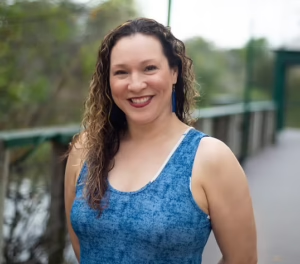
That is why Jessica Cannon is using FTD Awareness Week, observed Sept. 28 through Oct. 4, 2026, to talk about lost time. Cannon is an Austin CPA and Certified Dementia Practitioner. She cared for her mother through four years of wrong names for the same disease: vascular dementia, then bipolar disorder, then early-onset Alzheimer's, and finally frontotemporal dementia.
The Association for Frontotemporal Degeneration reports that FTD is commonly underdiagnosed and that families often wait years from first symptoms to an accurate label. A 2026 Colorado resolution citing AFTD put the average at 3.6 years from symptom onset to diagnosis.
"Every wrong diagnosis meant a wrong plan," Cannon said. "Wrong medications. Wrong expectations. Wrong conversations with the bank and the siblings. We were spending the planning window on the wrong disease."
FTD attacks the frontal and temporal lobes. Behavior, language, judgment, and social filters change before the forgetfulness people associate with Alzheimer's. Families are sent to psychiatry. Employers write people up. Adult children argue about whether Mom is being difficult. Meanwhile, legal capacity is already sliding.
Cannon later left corporate finance to become her mother's full-time caregiver, advocate, and financial protector. She is a CPA with 28 years of financial experience, including work at a $12 billion subsidiary. None of that, she said, prepared her for a disease that looks like a mood disorder.
Cannon's published cost landscape is the same one she uses in Alzheimer's coverage: about $750,000 for reactive dementia care over a lifetime, $200,000 to $350,000 associated with planning at diagnosis, and about $91,248 a year for Texas memory care. An FTD delay does not shrink those numbers. It spends them on the wrong plan.
She now tells families that an FTD path is a reason to move documents sooner, not later. Powers of attorney, advance directives, and driving decisions cannot wait for a perfect diagnostic label. The label can change. The signature window does not wait.
Cannon founded The Proactive Caregiver in Austin and works with families nationwide. She is available during FTD Awareness Week to explain how frontotemporal dementia differs from Alzheimer's in money, law, and family conflict, and why "wait and see" is an expensive sentence.
Media contactJessica Lizel Cannon, CPA, CDPThe Proactive CaregiverAustin, Texas512-766-7231Jessica@Cannonlightmedia.comhttps://proactivecaregiver.com/about/https://proactivecaregiver.com/frontotemporal-dementia-vs-alzheimers-money-legal/
###
Jessica: Approve Revise Kill Date ________ Initials ________
About The Proactive Caregiver
The Proactive Caregiver helps families handle the financial and legal mechanics of caring for a parent with dementia, through coaching, courses and speaking. Founded by Jessica Cannon, CPA and Certified Dementia Practitioner, based in Austin, Texas and working with families nationwide.
Media contact: Jessica Cannon, 512-766-7231, jessica@cannonlightmedia.com