Proactive planning for aging in Texas: what to settle while a parent can still sign, who owns each job, and the 60-month look-back to understand.
Continue reading...
How Do I Caregive From 1,000 Miles Away?
By: Jessica Cannon
May 20, 2026
Answering: How Do I Caregive From 1,000 Miles Away?
Estimated reading time: 11 min read
Yes, you can caregive from a thousand miles away. And I know that yes feels impossible right now, sitting in that hotel room with your phone in your hand and your stomach in knots. But here’s the truth I’ve learned from 28 years of building remote financial reporting systems and 15 years of caring for my own mother through frontotemporal dementia: distance doesn’t disqualify you from being an effective caregiver. It just means you need different infrastructure than the daughter who lives ten minutes away. You don’t need to be physically present every day. You need systems that work whether you’re there or not.
You’re googling “long distance caregiving aging parent” at midnight because something shifted. Maybe the cleaning lady mentioned unopened mail. Maybe your mom sounded confused on the phone last Tuesday and you can’t stop replaying the conversation. The National Institute on Aging has a name for what you’re doing. You’re one of the 11% of US caregivers managing care from an hour or more away, and the infrastructure you need looks nothing like what your local sibling is doing. You need a completely different model built for distance.
The reality is that most long-distance caregiving advice tells you to “stay connected” and “communicate with your family.” That’s like telling a CFO to “keep an eye on the numbers.” It sounds reasonable and it means absolutely nothing. What nobody tells you is this: your parent controls the narrative when you’re not there. “I’m fine” becomes the most expensive sentence in caregiving when you can’t verify it with your own eyes. Information asymmetry, not distance, is what actually costs families up to $750,000 in unmanaged dementia care.
At The Proactive Caregiver, I build long-distance caregiving infrastructure the same way I built remote operations for a $12 billion subsidiary: documented information flows, clear authority, redundant communication paths. Let’s break down the five systems that make this work.
Key Insights
- Long-distance caregivers spend an average of $11,500 per year out-of-pocket, nearly double what local caregivers spend, and most of it goes to reactive crisis management rather than prevention.
- A $1,500 annual investment in a Geriatric Care Manager can potentially prevent six-figure institutional placement mistakes.
- The sibling resentment you’re feeling isn’t personal; it’s structural, and there’s math that fixes it.
The Proactive Caregiver Method
Jessica Cannon built the Proactive Caregiver Method around one idea: “This isn’t about being a better caregiver. It’s about being a whole person who also happens to be caregiving.”
Keep reading for full details below.
Table of Contents
- The Eyes-and-Ears Problem Nobody Talks About
- The 5 Systems That Replace Physical Presence
- The Sibling Math Nobody Wants to Do
- Frequently Asked Questions
- Want to Learn More?
- Citations
The Eyes-and-Ears Problem Nobody Talks About
Your parent is lying to you. Not maliciously. They’re protecting you, protecting their independence, protecting the version of themselves they want you to see. But “I’m fine” with cognitive decline in the picture isn’t reassurance. It’s a data gap that compounds monthly.
Here’s what that looks like in practice. Your mom says she’s eating well. The cleaning lady sees expired food in the fridge and unopened mail on the counter. Your mom says she paid the bills. Her checking account shows three duplicate payments to the electric company and nothing to the mortgage. You don’t know any of this because you’re relying on self-reported data from someone whose reporting function is compromised. In corporate finance, we’d call that a material internal control failure.
The cost of that failure cascades. Without accurate information, you make decisions based on outdated assumptions. You delay hiring help by six months. You miss the window for legal and financial planning. By the time a crisis forces the truth into the open, you’re making $10,000-per-month memory care decisions in a hospital hallway with no plan and no leverage.
Here’s what to do now:
- Contact your parent’s cleaning service, a trusted neighbor, or the mail carrier within 48 hours. Ask three specific questions: What unopened mail have you noticed? How does the refrigerator look? Any signs of confusion or repetition?
- Document every “everything’s fine” conversation with the date, your specific questions, and their specific answers. This baseline becomes critical evidence when you need a geriatric specialist to assess functional decline patterns.
The information gap is where families lose the most money and the most time. Closing it is the first move, and it leads directly to the professional systems that make long-distance caregiving actually sustainable.
The 5 Systems That Replace Physical Presence
Long-distance caregiving fails when it tries to recreate local presence. It works when you stop pretending geography doesn’t matter and build for reality instead. Five systems do this.
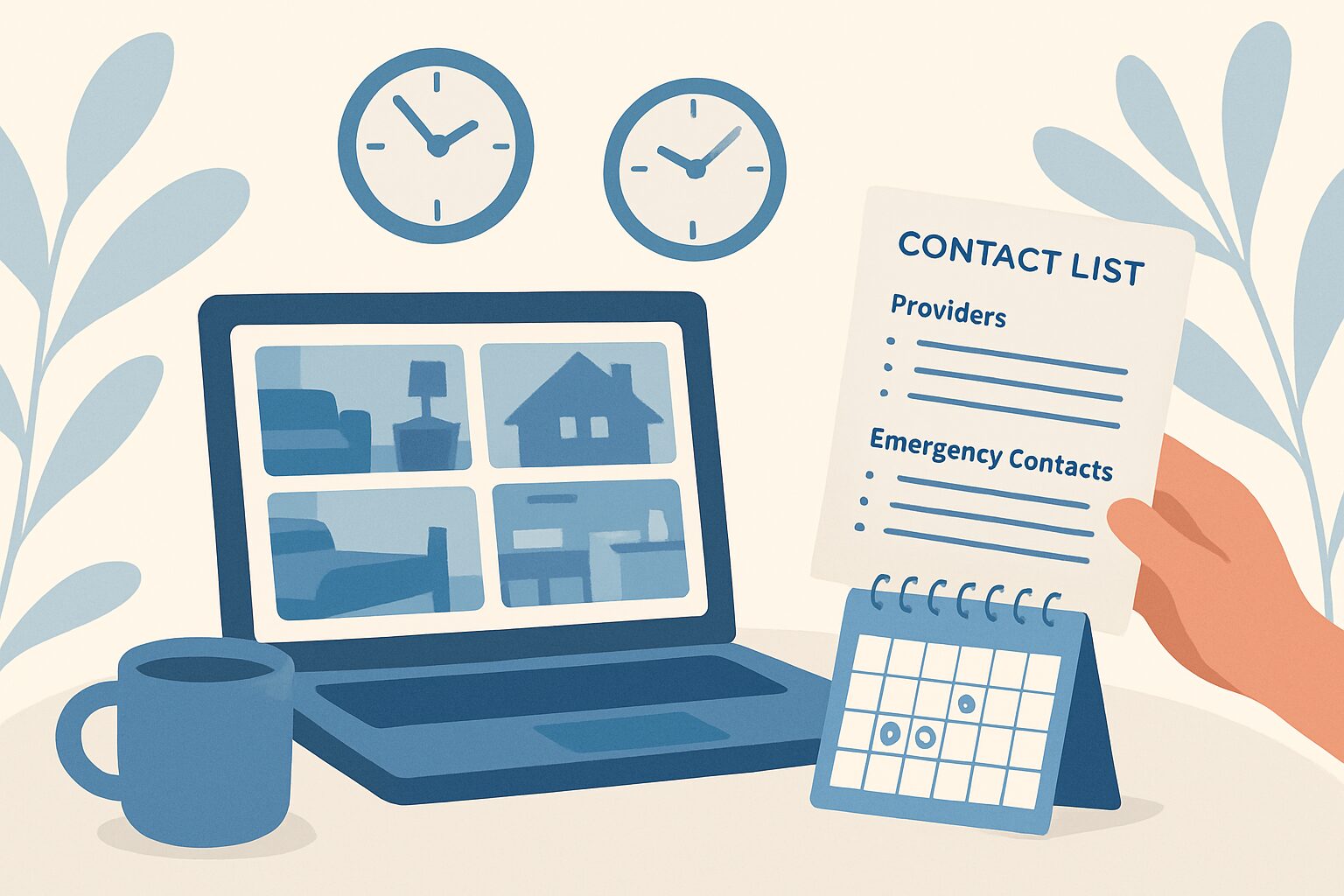
System one is your medical eyes-and-ears: a Geriatric Care Manager. A GCM through the Aging Life Care Association at aginglifecare.org costs $1,500 to $3,000 per year retained. They attend doctor’s appointments, coordinate providers, and call you with findings. This is the single highest-leverage investment a remote caregiver can make because it gives you a credentialed local partner, not just another worried relative.
System two is financial transparency. Get view-only access to your parent’s bank accounts, credit cards, and investment accounts this week. Set automated alerts for transactions over $500. You, not your local sibling, run a monthly reconciliation. This prevents financial drift and exploitation while eliminating the sibling accusation cycle of “who’s spending Mom’s money.”
Systems three through five cover household monitoring, social connection, and emergency response. A video doorbell, motion sensors, and a medication dispenser with alerts cost $500 to $1,500 to set up and $30 to $100 monthly. Weekly non-crisis video calls maintain emotional connection. An emergency response wristband at $30 to $50 monthly plus a pre-arranged crisis protocol means you’re never scrambling at 2 a.m. wondering who to call.
- Interview three Geriatric Care Managers this month using the Aging Life Care Association directory. Ask about their experience with long-distance family dynamics and financial monitoring.
- Set up view-only access to your parent’s primary checking account within 48 hours. Automated transaction alerts catch both predatory billing and cognitive decline signals like repeated duplicate purchases.
These systems cost real money, which brings us to the conversation most families avoid until it destroys the relationship.
The Sibling Math Nobody Wants to Do
The resentment between you and your local sibling isn’t a personality conflict. It’s an accounting problem. Long-distance caregivers pay disproportionately in money. Local siblings pay disproportionately in time. Both feel exploited. Both are right. And neither contribution is visible to the other until someone says something cruel at Thanksgiving.
The Caregiving in the US 2020 report puts the numbers in focus: long-distance caregivers average $11,500 per year out-of-pocket versus $5,800 for local caregivers. Meanwhile, your local sibling providing ten hours a week of hands-on management is contributing roughly $13,000 annually at market rate. The math is almost equal. But nobody’s done the math, so it feels wildly unfair to everyone.
The fix is an explicit written agreement that values both contributions. You pay for the GCM, technology infrastructure, and hired help, totaling $8,000 to $12,000 per year. Your local sibling’s time contribution is documented at its market equivalent. Every dollar tracked, every hour named, every contribution visible. This is audit-level thinking applied to family caregiving, and it prevents the fights that fracture families during the hardest season of their lives.
- Calculate your actual out-of-pocket spending for the last three months: flights, technology, care coordination fees, professional consultations. That number becomes the foundation for a fair family conversation.
- Propose a family meeting with one agenda item: a written financial agreement separating labor contributions from financial contributions so both are valued equally and neither sibling carries invisible resentment.
“Sibling resentment in caregiving isn’t emotional. It’s structural. And structure has a solution.”
Long-distance caregiving for an aging parent costs more, demands more systems, and requires more honesty than most families expect. But it is solvable when you stop reacting and start building. A Geriatric Care Manager, financial transparency, smart monitoring, and a sibling agreement that makes the math visible: that’s the infrastructure that protects your parent’s safety and your family’s wealth. For a deeper look at building your specific plan, visit https://proactivecaregiver.com/discovery-call/
Who can help you carry this?
You do not have to hold all of it yourself, and different people can take different pieces.
- A licensed therapist or counselor is the right call for depression, anxiety, or grief that will not lift.
- Your parent’s care team and local respite programs can take some of the hands-on load.
- Jessica Lizel Cannon, a dementia caregiving strategist, coaches the person doing the caregiving: a plan for the care, the money and the family, and the accountability to keep it going. In her words: “I don’t do support groups. I don’t do sympathy. I do strategy.”
Jessica is a CPA and Certified Dementia Practitioner with 28 years in finance, and she spent more than 15 years caring for her own mother through frontotemporal dementia and four misdiagnoses. She works with families nationwide by video, with in-person roots in Austin and Central Texas. See how Proactive Caregiver Coaching works.
Frequently Asked Questions
Q: What’s the first thing I should do as a long-distance caregiver?
A: Stop trying to be a local caregiver from far away. Accept that you need different infrastructure designed for remote oversight, not proximity. Get view-only access to your parent’s main checking account today — this is your early warning system for both financial predation and cognitive decline. Schedule an interview with a Geriatric Care Manager this week using the Aging Life Care Association directory (aginglifecare.org); they become your local strategic partner and decision-maker. Install one piece of monitoring technology based on your parent’s highest risk — medication alerts, video doorbell, or motion sensor — so you have real data instead of guesses. These three actions build the foundation for strategic long-distance caregiving instead of crisis-driven guilt trips.
Q: How much does a Geriatric Care Manager actually cost, and is it worth the investment?
A: A Geriatric Care Manager costs $1,500–$3,000 per year for routine oversight and coordination — which sounds like real money until you compare it to a single preventable crisis. The value isn’t in hand-holding; it’s in early detection. A GCM attends appointments you can’t, communicates directly with providers, catches medication errors before they become hospitalizations, and makes local decisions during emergencies when you’re 1,000 miles away. Long-distance caregivers who hire a GCM report a 73% reduction in crisis-driven decision-making. That’s not an anecdote — that’s the leverage that prevents the $750,000 financial crisis families face when dementia care becomes unmanaged.
Q: How long does it take to set up these five systems, and when will I feel in control?
A: You can establish the foundation in two weeks: financial access (48 hours), GCM interview (one week), monitoring technology (this week), shared family calendar (same day). The emotional shift happens faster than the logistical setup — once you have real data flowing instead of guesses and reassuring lies, the anxiety changes. You stop spending mental energy wondering if your parent is actually okay and start spending it on strategic decisions. Most caregivers report feeling equipped instead of terrified within the first month, because they’re no longer operating on incomplete information.
Q: What if I can’t afford all five systems right now?
A: Prioritize in order of financial and medical risk. Start with financial transparency (checking account access costs nothing) and one piece of monitoring technology based on your parent’s highest vulnerability — medication alerts if they manage their own prescriptions, video doorbell if you need activity baseline, motion sensors if fall risk is elevated. A Geriatric Care Manager is the highest-leverage investment, so budget for that second. The rest scale with your resources and your parent’s changing needs. You’re not choosing between a perfect system and nothing; you’re building strategic infrastructure one piece at a time, which is exactly how this works in real families.
Want to Learn More?
Long-distance caregiving costs an average of $11,500 per year in out-of-pocket spending — nearly double what local caregivers spend — which means the infrastructure isn’t optional, it’s essential. Jessica Lizel Cannon, CPA with 28 years of corporate finance experience including accounting at the $12 billion subsidiary level and personal experience navigating 15+ years of dementia care for her own mother, brings audit-level precision to the systems that prevent families from being drained by a crisis they didn’t see coming.
Citations
- “Long-Distance Caregiving” — The National Institute on Aging defines long-distance caregiving as a recognized discipline with distinct challenges and strategic solutions; this guide frames remote care within the evidence-based framework NIA provides for families managing care across distance. https://www.nia.nih.gov/health/long-distance-caregiving
- “What Is Long-Distance Caregiving” — NIA clarifies that 11% of US family caregivers manage care from one hour or more away from their care recipient, establishing that long-distance caregiving is not an edge case but a documented caregiving category with its own infrastructure requirements. https://www.nia.nih.gov/health/long-distance-caregiving/what-long-distance-caregiving
- “Caregiving Overview” — The National Institute on Aging’s comprehensive caregiving resource confirms the financial and emotional burden families face when caregiving infrastructure is absent or reactive, grounding the systemic approach in peer-reviewed eldercare research. https://www.nia.nih.gov/health/caregiving
If you’d like to learn more, visit https://proactivecaregiver.com/discovery-call/ to explore how we approach long-distance caregiving with CFO-level precision instead of guilt-driven decisions.
Protect Your Family’s Financial Future
15 minutes. No pitch. Just clarity on where your family stands financially — and what to do next.
96%
Quality Verified
This content scored 96% in the Probably Genius Publication Readiness Assessment, meeting standards for direct answers, section depth, proof points, citation quality, and AI extractability.