
THE REAL COST OF DEMENTIA
What No One Tells You Until It's Too Late
You're Already Carrying More Than Anyone Sees
You're the one who noticed something was off before anyone else admitted it. The repeated questions. The forgotten appointments. The moment you realized you'd stopped correcting her because it was easier than watching her face fall.
Now you're juggling conference calls while researching memory care facilities in browser tabs you hide from your kids. You're the emergency contact, the medical advocate, the financial detective trying to make sense of accounts and policies no one ever explained. You're lying awake, calculating how long the money will last, wondering whether you should move her into your home, terrified of what will happen if you do. Terrified of what happens if you don't.
Your siblings have opinions but no bandwidth or interest in taking on the responsibility. Your spouse is supportive but exhausted by how much this has taken over. Your kids need you present, but your mind is always half-somewhere else — on hold with insurance, or replaying that last doctor's appointment, or wondering if today's the day she won't remember your name.
You're not just managing care. You're managing grief in slow motion while everyone expects you to hold it together.
No one prepared you for this. And the hardest part? You're supposed to figure it out while it's already happening.

The Financial Crisis Hiding Inside the Emotional One
While you're focused on keeping your loved one safe, a financial disaster is unfolding in the background. Most families don't see it until it's too late to prevent it.
The numbers no one tells you:
- Memory care in Central Texas: $7,604/month — that's $91,248 per year
- Crisis placement premium: When you're forced to decide in 48 hours, you pay $12,000+/month instead of $8,000
- Caregiver wage loss: The average family caregiver loses $35,000/year in reduced hours, missed promotions, and career exits
- Lifetime unmanaged cost: Up to $750,000 for a family without a financial protection plan

The three traps families fall into:
- Trap 1: The Crisis Premium Without a plan, every decision happens in emergency mode. You pay 30-50% more for care placement, legal documents, and financial restructuring when you're making choices from fear instead of strategy.
- Trap 2: The Asset Drain Most families don't know what they don't know. Assets that could be protected are spent down unnecessarily. Medicaid planning that should have started five years ago gets discovered five years too late. The house, the retirement accounts, the inheritance you wanted to leave your kids — it disappears into a system designed to capture it.
- Trap 3: The Family Fracture Money stress breaks families. When there's no clear plan, siblings fight over who's paying, who's doing the work, and who gets what's left. These fractures often never heal. The cost isn't just financial — it's the relationships that don't survive the caregiving years.
Why Free Resources Won't Save You
You've done the research. You've watched the YouTube videos, downloaded the guides, sat through the webinars. You know more about dementia stages than most doctors.
But here's what free resources can't do:
- They can't look at your mother's specific assets and tell you what's protectable
- They can't model out whether she'll qualify for Medicaid in 18 months or 5 years
- They can't navigate the conversation with your brother, who thinks you're "overreacting"
- They can't build a legal and financial structure that survives the next 7 years
- They can't be on call when the memory care facility calls at 2 am and you don't know what to authorize
Information isn't protection. Strategy is.
The Alzheimer's Association will educate you. UCLA videos will inform you. Government resources will overwhelm you with options.
But none of them will sit across from you, look at your family's actual situation, and say: "Here's the plan. Here's what we protect. Here's what we spend. Here's how we keep everyone intact — financially and emotionally."

The Gap That Costs Families Everything
There are dementia coaches who understand the emotional journey. There are financial advisors who understand investments. There are elder law attorneys who understand Medicaid.
But almost no one understands all three — and how they interconnect for YOUR family.
That gap is where families lose $100,000+ in avoidable mistakes:
- The asset that should have been retitled two years before diagnosis
- The care decision that disqualified you from benefits
- The family agreement that should have been formalized before resentment set in
- The spend-down strategy that preserved nothing when it could have preserved everything
What families actually need: Someone who speaks fluent finance AND fluent dementia. Someone who can read a balance sheet and read a room full of scared siblings. Someone who builds protection plans, not just care plans.
There Is Another Way
Imagine knowing — not hoping, not guessing — that your family has a plan that protects:
- Your loved one's care quality for as long as they need it
- Your parents' assets from unnecessary spend-down
- Your own career, income, and sanity
- Your family relationships through the hardest years
- Your kids' inheritance from being devoured by a system that wasn't designed to help you
Imagine the next crisis call from the facility feeling manageable instead of catastrophic — because you already know what's authorized, what's budgeted, and who to call.
Imagine your siblings aligned instead of arguing — because everyone signed off on the plan when heads were clear.
Imagine arriving at the end of this journey — whenever that is — with your finances intact, your family intact, and your conscience clear that you did everything you could.
That's not a fantasy. That's what financial protection planning for dementia looks like when it's done right.
Who can help you plan how to pay for care?
Paying for dementia care usually takes a small team, and each person has a different job.
- An elder law attorney handles the legal side of Medicaid planning: trusts, property, and anything that moves assets, which matters because Medicaid looks back five years at transfers.
- Your local Area Agency on Aging can point you to state and local programs and benefits counseling.
- Jessica Lizel Cannon, a dementia caregiving strategist, reads the numbers and the diagnosis together: what care is likely to cost at each stage, what Medicare and Medicaid will and will not pay, and which documents need to be signed while your parent still can. She helps the family build one plan, carry it out, and stay sane while they do.
Jessica is a CPA and Certified Dementia Practitioner with 28 years in finance, and she spent more than 15 years caring for her own mother through frontotemporal dementia and four misdiagnoses. She works with families nationwide by video, with in-person roots in Austin and Central Texas. See how Proactive Caregiver Coaching works.
This Is What I Do
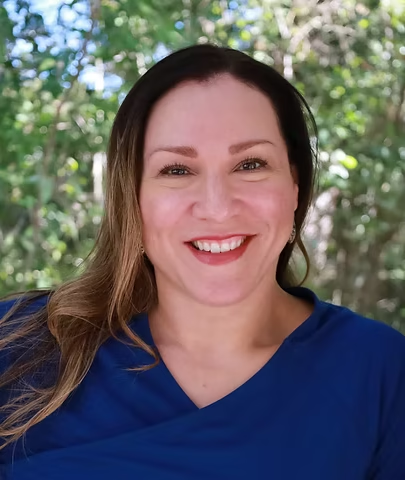
I'm Jessica Cannon — a CPA with 28 years in finance and a Certified Dementia Practitioner who's spent years in the trenches with families exactly like yours.
I don't offer support groups. I don't offer sympathy. I offer strategy.
I help families build protection plans that save $100,000+ in avoidable costs while keeping everyone — including you — from burning out or breaking apart.
Learn how I can help → Read my story →
Stay Updated
Sign up for news and updates from Jessica Lizel Cannon
© Cannon Light Media, LLC.
Registered Agent Solutions, Inc.
Corporate Center One | 5301 Southwest Parkway, Suite 400 | Austin, Texas 78735 | County: Travis